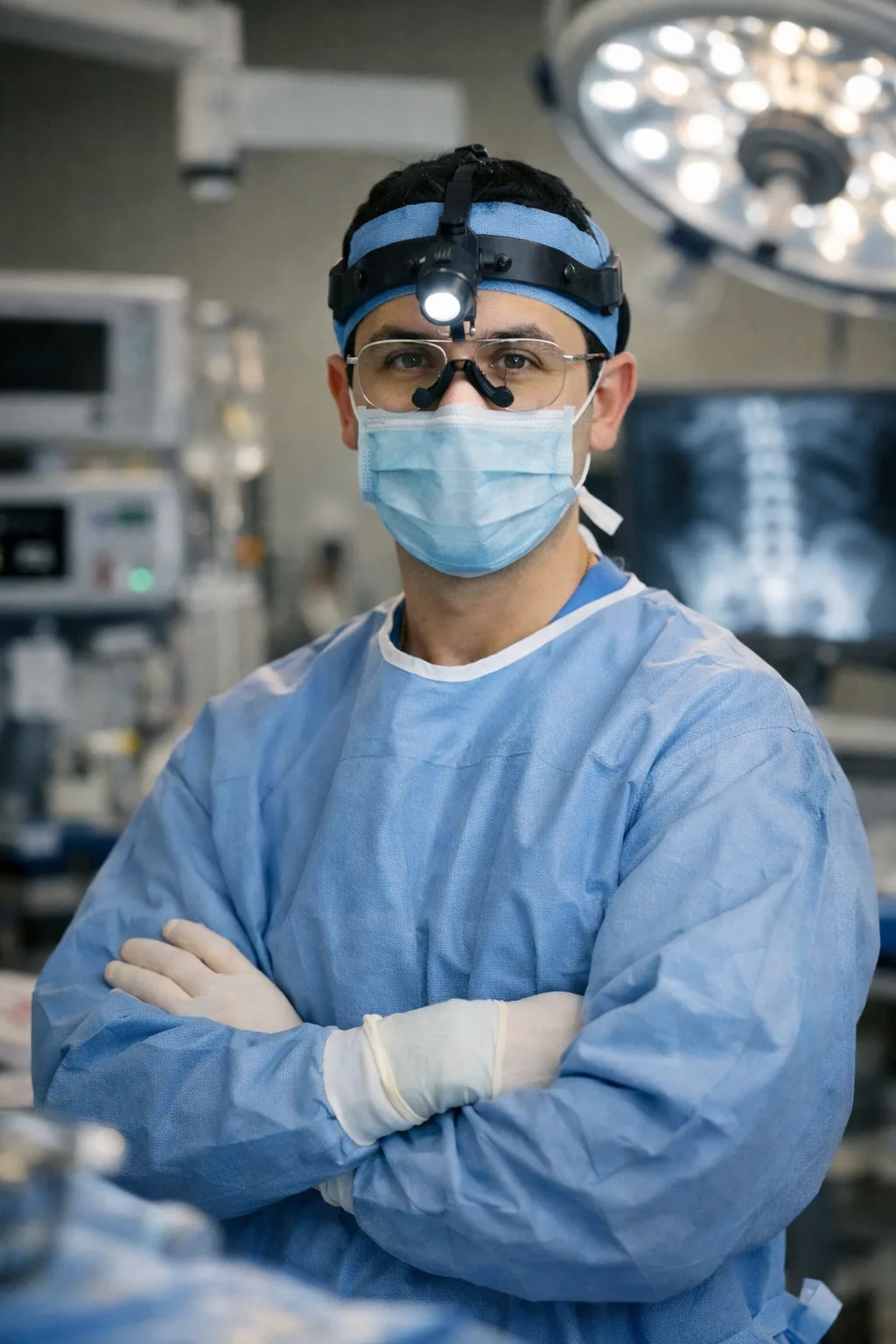
Mayo Clinic MD · Johns Hopkins residency · Brown spine fellowship
Minimally invasive spine surgery, personalized for you.
Dr. Marc Greenberg emphasizes the least disruptive option that safely addresses the problem — including endoscopic and motion-preserving techniques when the anatomy allows, and honest guidance when surgery is not appropriate.
Now open in Fort Wayne. Request an appointment online or call (260) 484-8551.
Mayo Clinic MD · Johns Hopkins Residency · Brown Spine Fellowship

Meet Dr. Marc Greenberg
A fellowship-trained spine surgeon in Fort Wayne
Dr. Marc Greenberg is a fellowship-trained spine surgeon with Orthopaedics Northeast in Fort Wayne whose practice focuses on minimally invasive spine surgery, motion-preserving options, and robotic-assisted procedures when appropriate. Dr. Greenberg earned his medical degree at Mayo Clinic, completed orthopedic surgery residency at Johns Hopkins, and completed spine surgery fellowship training at Brown University.
When surgery is the right choice, the goal is the smallest effective approach and the least unnecessary tissue disruption. For conditions that improve without surgery, the same evidence-based rigor guides every non-surgical recommendation.
- Mayo Clinic Alix School of Medicine — Medical Degree (MD)
- The Johns Hopkins Hospital — Orthopedic Surgery Residency
- Brown University — Spine Surgery Fellowship

Fort Wayne North office
Visit Greenberg Spine in Fort Wayne
Dr. Marc Greenberg sees patients by appointment at Orthopaedics Northeast on Fort Wayne’s north side.
- Appointments
- Request an appointment online
- General office
- (260) 484-8551
- Phone hours
- Monday–Friday, 8:00 AM–5:00 PM
- Parking and arrival
- Call before your visit if you need current parking, accessibility, or building-entry guidance.
The Minimally Invasive Approach
Smaller working corridors when they can safely accomplish the surgical goal
Smaller Access
Smaller Access
Minimally invasive techniques use smaller working corridors when they fit the anatomy
Recovery Planning
Recovery Planning
Activity timelines are individualized by diagnosis, procedure, and overall health
Less Tissue Disruption
Less Tissue Disruption
The goal is to address the problem while protecting healthy muscle and tissue
Efficient Care
Efficient Care
Selected procedures may be outpatient when that is safe and appropriate
Ready to Take the First Step?
Greenberg Spine is now open in Fort Wayne. Request an appointment, or ask for a second opinion before you commit to a proposed operation.
Free guide
Making Sense of Spine Surgery
An evidence-based overview covering what to expect — from diagnosis and treatment options through recovery.
Our Approach
Recommendations are based on the diagnosis, examination, imaging, prior treatment, health factors, and patient goals.
- Non-Surgical FirstMost conditions begin with nonsurgical care. Surgery is considered when the diagnosis, symptoms, objective findings, imaging, prior treatment, and goals support it; urgent neurologic findings can change the timing.
- Evidence-Based DecisionsRecommendations draw on peer-reviewed evidence, the clinical examination, the actual imaging, prior treatment, function, health factors, and the patient’s goals.
- Clear CommunicationThe discussion should connect the diagnosis, imaging, reasonable options, uncertainty, and patient-specific recovery milestones in plain language.
- Referral CoordinationRecords and care plans can move through the secure clinical channels designated by the office when coordination is needed.
- Second OpinionsIf another surgeon told you surgery is your only option, get a second look. Dr. Greenberg reviews your imaging and evaluates whether minimally invasive or non-surgical approaches may be appropriate.
- Motion-Preserving OptionsWhen surgery is needed, fusion is not always the answer. Cervical disc replacement is designed to preserve motion, and selected disc herniations may be treated without fusion. Fusion is used when the anatomy and surgical objective require it.
Conditions Evaluated
Common cervical, lumbar, neurologic, and postoperative spine concerns
Procedures
Procedure options selected according to the diagnosis, anatomy, and surgical objective
Six Offices Across the Region
Accepting appointments in Fort Wayne, Bryan, Warsaw, and Angola
- Fort Wayne
- Bryan
- Warsaw
- Auburn
- Kendallville
- Wabash
- Angola
- Huntington
Greenberg Spine serves Northeast Indiana and Northwest Ohio through Orthopaedics Northeast. All six offices are accepting appointments: Fort Wayne North, Clinton, Southwest, Bryan, Warsaw, and Angola.
See areas we serveFeatured In
Parkview Health
Parkview Health featured Dr. Greenberg discussing how minimally invasive and endoscopic spine surgery techniques can allow spinal decompressions through smaller working corridors, with the goal of reducing unnecessary tissue disruption.
View featured coverageSpine Insights
Patient education on spine conditions, decisions, and treatments
MRI Guide · 10 min read
Severe Foraminal Stenosis on MRI: What It Means
Why a severe MRI grade does not decide treatment by itself—and how the level, side, symptoms, examination, and function fit together.
Read articleCervical Spine · 10 min read
Cervical Radiculopathy vs. Myelopathy
Compare nerve-root and spinal-cord symptoms, what MRI adds, why the treatment goals differ, and which changes need prompt evaluation.
Read articleNeurologic Symptoms · 11 min read
Foot Drop From a Herniated Disc or Pinched Nerve
How clinicians localize foot drop, when MRI and EMG help, what affects recovery, and which warning signs require emergency care.
Read articleFrequently Asked Questions
How quickly can I get an appointment?
Greenberg Spine is now open in Fort Wayne. Request an appointment online or call (260) 484-8551; the office will follow up about availability and next steps.
Do I need a referral to see Dr. Greenberg?
Referral requirements vary by insurance plan and circumstance. Contact the office and your health plan to confirm what is required before the visit.
What makes minimally invasive spine surgery different?
Minimally invasive techniques use smaller working corridors, specialized instruments, and advanced imaging to reach the spine while limiting unnecessary tissue disruption. The appropriate approach depends on the diagnosis, anatomy, and surgical goal.
How do I know if I need spine surgery?
Most spine conditions do not require surgery. It is considered when symptoms, examination, and imaging identify a structural problem that is likely to improve with an operation, or when progressive neurologic findings change the balance of options. The evaluation should also explain when surgery is unlikely to help.
What insurance do you accept?
Insurance participation and coverage vary by plan and service. Confirm benefits and network status directly with your health plan. The office can explain its own scheduling and billing requirements, but website information is not confirmation of coverage or payment.
Take the Next Step
Greenberg Spine is now open in Fort Wayne. Request an appointment, or ask for a second opinion before you decide about spine surgery.