
Blog
Arm Pain Map: What C5, C6, C7, and C8 Symptoms Can—and Can't—Tell You

C5 often affects the shoulder and outer upper arm, C6 the thumb side of the forearm and hand, C7 the back of the arm toward the middle finger, and C8 the inner forearm into the ring and little fingers. These patterns overlap, so clinicians combine the symptom route with strength, reflexes, and imaging that matches.
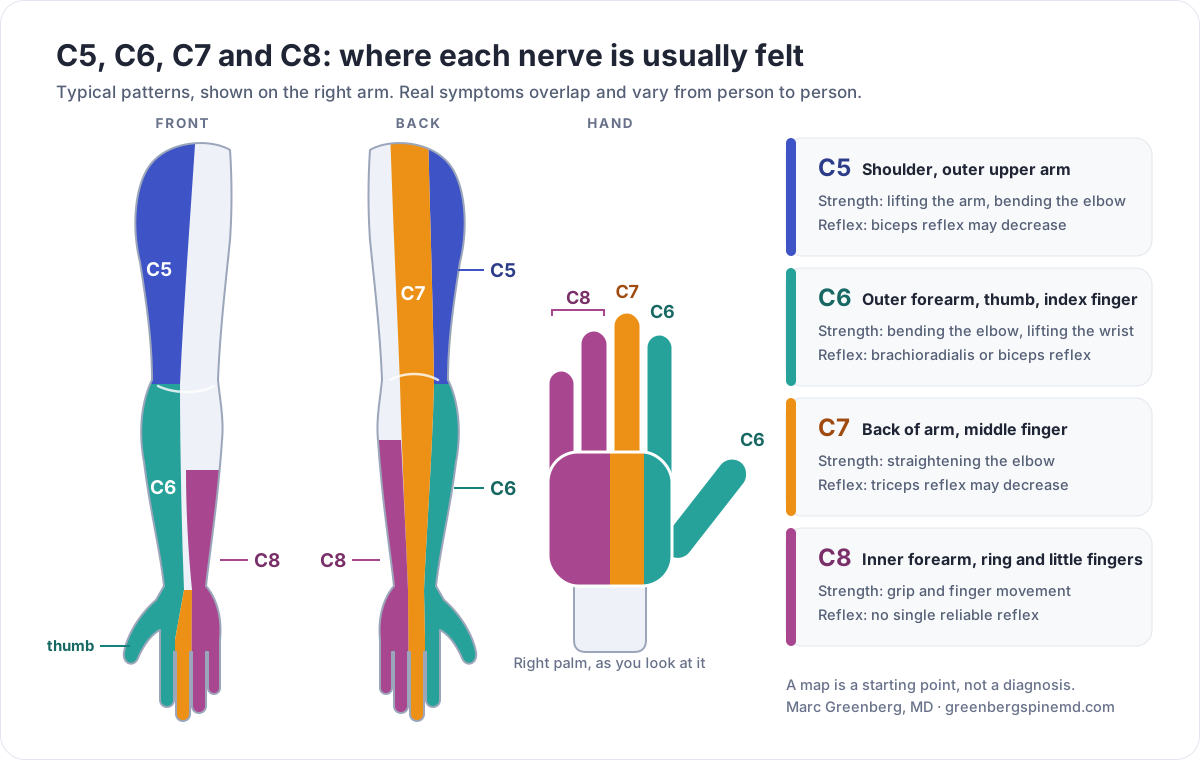
“Point to where the pain goes.” When someone describes pain running from the neck into the arm, that is one of the first things I ask. The route often hints at which cervical nerve root may be irritated. Pain over the shoulder points somewhere different from tingling in the thumb or numbness in the little finger.
But an arm pain map is a starting point, not a diagnosis. Nerve-root territories overlap. Shoulder, elbow and wrist problems can produce look-alike symptoms. The likely root becomes convincing only when the symptom route, the strength examination, the reflexes and, if imaging is needed, the MRI all point to the same side and the same level.
C5, C6, C7, and C8 at a Glance
| Nerve root | Common pain or numbness clues | Strength clues a clinician checks | Reflex clue |
|---|---|---|---|
| C5 | Neck and shoulder, outer upper arm | Raising the arm out to the side (deltoid); bending the elbow (biceps) | Biceps reflex may decrease |
| C6 | Thumb side of the forearm into the thumb and index finger | Bending the elbow; lifting the wrist backward | Brachioradialis or biceps reflex may decrease |
| C7 | Back of the arm and forearm toward the middle finger | Straightening the elbow (triceps); bending the wrist | Triceps reflex may decrease |
| C8 | Inner forearm into the ring and little fingers | Gripping with the finger flexors; small muscles of the hand | No standard reflex points specifically to C8 |
These are textbook patterns, and real people often depart from them. In a study of patients whose single-level cervical radiculopathy improved substantially after anterior cervical discectomy and fusion, the pain and numbness matched the standard diagram in only 54% of 239 levels. Neck pain on the same side was the most common symptom of all. The map still helps; it needs the examination beside it.
What Is a Cervical Nerve Root, and What Does the Examination Ask?
The neck has seven vertebrae but eight pairs of cervical nerves. Each nerve root leaves the spinal canal through a small opening on the side of the spine, called a foramen, and then joins the network of nerves that supplies the shoulder, arm and hand. When a disc herniation, a bone spur or narrowing of that opening irritates the root, the result may be cervical radiculopathy.
Each root carries sensation, muscle signals and part of certain reflexes, so the examination asks:
- Where exactly is the numbness or tingling?
- Which movement is weak compared with the other arm?
- Is a reflex reduced on the painful side?
- Does tilting and extending the neck toward the painful side (Spurling’s test) reproduce the familiar arm pain?
- Does resting the hand on top of the head ease the arm pain? This is called the shoulder abduction relief sign.
- If imaging is needed, does it show compression on the same side at a level that fits?
No single test settles the question. A systematic review found that Spurling’s test has low to moderate sensitivity and high specificity, and the shoulder abduction test has low to moderate sensitivity and moderate to high specificity. A positive result adds weight when the rest of the story agrees; a negative result does not rule the diagnosis out.
What Does C5 Nerve Pain Feel Like?
C5 irritation often causes aching over the shoulder and the outer part of the upper arm. The motor examination focuses on the deltoid, which raises the arm out to the side, and the biceps, which bends the elbow. The biceps reflex may be reduced.
The main imitator is the shoulder itself. Rotator cuff disease, a stiff shoulder and arthritis can all cause pain in the same region. Shoulder pain that worsens with certain arm movements, without numbness and without neck pain, points more toward the joint. The guide to cervical radiculopathy versus shoulder pain walks through those differences.
What Does C6 Nerve Pain Feel Like?
C6 symptoms often travel from the neck along the thumb side of the forearm into the thumb and index finger. Weakness may show up when bending the elbow or lifting the wrist backward. The brachioradialis reflex, tapped near the wrist, or the biceps reflex may decrease.
Carpal tunnel syndrome is the classic look-alike because it also numbs the thumb side of the hand. Carpal tunnel symptoms tend to stay in the hand, may be worse at night and usually spare the forearm and neck. The two can also occur together. The comparison of carpal tunnel and cervical radiculopathy covers the tests that help tell them apart.
What Does C7 Nerve Pain Feel Like?
C7 is one of the roots most often affected. In a population-based study from Rochester, Minnesota, C7 was the most frequent single root involved, followed by C6. The pain often runs down the back of the arm and forearm, and the numbness may center on the middle finger. The triceps, which straightens the elbow, and the wrist flexors are the muscles a clinician usually checks. The triceps reflex may be reduced.
Middle-finger numbness can also come from carpal tunnel syndrome. One-sided triceps weakness with a matching reflex change points more convincingly to the root.
What Does C8 Nerve Pain Feel Like?
C8 symptoms often follow the inner side of the forearm into the ring and little fingers. Because C8 supplies the finger flexors and contributes to the small muscles of the hand, some people first notice a weaker grip or trouble with fine tasks rather than pain. No routinely tested reflex is specific to C8, so sensation and hand strength carry more of the examination.
The ulnar nerve at the elbow, the problem behind cubital tunnel syndrome, causes numbness in the same two fingers and is a frequent look-alike. Ulnar nerve symptoms usually spare the inner forearm and may worsen when the elbow stays bent. Thoracic outlet syndrome can also affect the inner arm and hand.
Why Do Neck Disc Levels and Nerve Numbers Line Up Differently Than in the Low Back?
In the neck, each nerve root from C1 to C7 leaves the spine above the vertebra that shares its number. There is no C8 vertebra, so the C8 root exits between C7 and T1. Below that point, each nerve is named for the vertebra above it.
| Disc level | Root usually affected |
|---|---|
| C4-C5 | C5 |
| C5-C6 | C6 |
| C6-C7 | C7 |
| C7-T1 | C8 |
So a C5-C6 disc herniation usually affects the C6 root, and a C6-C7 herniation usually affects C7. In the neck, the root at risk is generally the one leaving through the opening at that disc level.
The low back works differently. The root exiting at L4-L5 is L4, yet a typical L4-L5 herniation more often presses on L5, the root traveling down past the disc. A far-lateral herniation at the same level can affect L4 instead. The L4, L5, and S1 leg pain map explains the lumbar version in detail.
Why Might Your Arm Pain Not Follow a Textbook Dermatome?
A dermatome is the strip of skin associated with one nerve root. Dermatome maps are averages. Neighboring roots overlap, individual anatomy varies, and an inflamed root can produce pain across a wider area than its sensory strip.
In the study cited above, patients who did not follow the standard pattern were off by more than one dermatome on average. A scoping review of the neurological examination in cervical radiculopathy also found that reduced reflexes were the most specific finding, while sensory testing was the least sensitive. That is why I look for several findings that agree rather than relying on one symptom or one test.
What Else Can Look Like a Pinched Nerve in the Neck?
Arm pain, numbness and weakness have many possible sources. A careful evaluation also considers:
- Rotator cuff and other shoulder disease, which can cause shoulder and upper-arm pain that resembles C5, usually without hand numbness.
- Carpal tunnel syndrome, which numbs the thumb, index and middle fingers and can mimic C6 or C7.
- Ulnar nerve entrapment at the elbow, which can numb the ring and little fingers and weaken the hand, much like C8.
- Peripheral neuropathy, which often affects both hands or both feet symmetrically rather than one strip of one arm.
- Thoracic outlet syndrome, in which compression between the neck and the armpit causes arm and hand symptoms that do not map to a single root.
- Brachial neuritis (Parsonage-Turner syndrome), an inflammatory condition of the nerves beyond the spine that may begin with intense shoulder pain followed by weakness.
Heart disease can also cause arm pain. Arm pain that comes with chest pain, pressure, shortness of breath or sweating is an emergency. Call 911 rather than waiting to see whether it is a nerve problem.
What If Both Hands Feel Clumsy?
One pattern is not a nerve-root map at all. When the spinal cord itself is compressed in the neck, the condition is called cervical myelopathy. It tends to cause clumsy hands, dropping things, trouble with buttons or handwriting, a change in balance or walking, and symptoms in both hands or in the legs. Arm pain may be mild or absent.
Myelopathy is evaluated differently and more promptly than a pinched nerve, because the goal is to keep the spinal cord from losing further function. The guides to radiculopathy versus myelopathy and the early signs of cervical myelopathy explain what to watch for.
When Does an Arm Pain Map Make an MRI More Useful?
An MRI is most useful when the history and the examination have already framed a question. If left-sided pain into the middle finger, triceps weakness and a reduced triceps reflex all suggest C7, then a left-sided C6-C7 herniation or foraminal narrowing becomes meaningful. If the scan shows compression only on the right, or at a level that does not fit, the finding may be incidental.
Disc changes are common in people without symptoms. In a study of 1,211 healthy volunteers without symptoms, aged 20 to 70, 87.6% had disc bulging on cervical MRI, and most people in their twenties already did. A report that lists several bulging discs does not mean each one is causing pain. The overview of MRI and CT for the spine explains what each scan shows.
Will a Pinched Nerve in the Neck Get Better Without Surgery?
For many people, yes. In the Rochester population study, 90% of people with cervical radiculopathy were symptom-free or only mildly limited at their last follow-up, a median of about five years later, although about a quarter had surgery during that time. A systematic review of cervical disc herniation with radiculopathy found that substantial improvement tends to occur within the first four to six months.
When symptoms persist, weakness progresses, or the examination and MRI clearly match, surgery may be considered. The usual operations are anterior cervical discectomy and fusion (ACDF) and, in selected patients, cervical disc replacement. Posterior cervical foraminotomy is another option that exists for some root problems. The right choice depends on the specific anatomy and the person.
When Should Arm Pain or Weakness Be Evaluated Promptly?
Arrange a prompt assessment for new or worsening arm or hand weakness, spreading numbness, hand clumsiness or a change in balance. Pain that stays severe after an appropriate period of care also deserves a diagnosis.
Go to an emergency department for:
- new loss of bladder or bowel control;
- inability to urinate despite feeling full;
- new numbness around the groin, saddle, or inner thighs;
- rapidly worsening weakness in one or both arms or legs;
- arm pain with chest pain, pressure, shortness of breath or sweating; or
- severe new neck pain after major trauma.
What to Bring to a Spine Evaluation
Bring the MRI images themselves, the written report and a short timeline. Note where the symptom starts, where it travels, which fingers feel numb, and whether your grip, handwriting or balance has changed. A simple drawing is enough.
The goal is to see whether the map, the examination and the images agree on one source, and whether that source calls for time, therapy, medication, an injection or an operation. If symptoms are persistent, worsening or hard to pin down, you can request a new patient consultation or a second opinion. For office details, see the page on neck care in Fort Wayne.
Sources
- Observed patterns of cervical radiculopathy (McAnany et al., PMID 30121324)
- Hand manifestations of cervical myelopathy and radiculopathy (PMID 38567008)
- Neurological examination for cervical radiculopathy: scoping review (PMID 40188056)
- Provocative neck tests: systematic review (Rubinstein et al., PMID 17013656)
- Epidemiology of cervical radiculopathy (Radhakrishnan et al., PMID 8186959)
- Cervical MRI findings in asymptomatic subjects (Nakashima et al., PMID 25584950)
- Course of cervical disc herniation with radiculopathy (Wong et al., PMID 24614255)
- AAOS OrthoInfo: Cervical Radiculopathy
- NHLBI: Heart Attack Symptoms
This is general educational information, not medical advice. A clinical evaluation is the only way to know what’s right for you.