Blog
Cervical Disc Replacement: Who It Fits, and How These Implants Fail

A cervical disc replacement takes out a worn disc in the neck and puts in an implant that still moves. The device labels cover arm pain, numbness, or weakness from a herniation or bone spur between C3 and C7, at one level or two next to each other, usually after six weeks of nonsurgical care. Over ten years extra bone commonly grows around the implant, and one design failed by shedding wear particles.
When a disc in the neck is pressing on a nerve and the pain has not settled with time, therapy, and medication, two operations tend to get discussed. One takes the disc out and lets the two bones grow together. The other takes the disc out and puts in an implant that still moves. This page is about the second one, including the part that rarely makes it into a brochure: how these implants fail, and what has changed because of it.
What the operation actually is
The surgeon works through the front of the neck, takes out the worn disc along with whatever is pressing on the nerve, and puts an implant where the disc used to be. The medical name is cervical disc arthroplasty, and the shorter name most people hear is a cervical disc replacement. The point of the implant is to keep that level bending instead of locking it. Our cervical disc replacement page walks through the operation itself in more detail.
Which necks the labels actually cover
Every one of these implants came to market through a premarket approval, and each carries a label describing who it was tested on. Read together, those labels cover skeletally mature adults with arm pain, numbness, or weakness coming from a disc herniation or a bone spur between C3 and C7, confirmed on imaging. That pattern of symptoms is cervical radiculopathy. Some labels also include pressure on the spinal cord itself, which is cervical myelopathy. One level can be treated, or two levels next to each other. Most labels ask for at least six weeks of nonsurgical care first, or for symptoms that are getting worse on their own.
What rules it out
Plenty of necks are excluded before the conversation starts, and the exclusions are the more useful half of the label. Badly worn facet joints behind the disc rule it out, because those joints have to carry the motion the implant preserves. Thin bone on a DEXA scan rules it out. So does a segment that already shifts too far on bending X-rays, bone spurs that have bridged the level, a neck that has lost its normal curve, active infection, and a known allergy to the implant materials.
When a moving implant is ruled out, fusion is the usual alternative, and it is also the operation these implants were tested against. If you are weighing the two, we lay them side by side in cervical disc replacement versus ACDF, and the ACDF page covers the fusion in its own right.
Bone can grow around the implant
The most common way one of these implants stops behaving like a joint is that bone grows around it. The medical name is heterotopic ossification. In pooled studies following patients at least ten years, that bone was found in about 70 out of 100 people, and in about 37 out of 100 it blocked or bridged the level. Average motion at the treated level went from 8.6 degrees before surgery to 7.4 degrees ten years afterward.
That is worth sitting with, because it reframes what a disc replacement promises. It is not a guarantee of permanent motion. Bending X-rays are how a surgeon checks whether an implant is still moving and still sitting where it was placed, and they are part of the standard follow-up rather than something you only get if something feels wrong.
The failure that changed the conversation
One design failed in a way its five-year trial did not show. The M6-C wound polyethylene fiber around a soft core and held the whole thing inside a plastic sheath. Published reports described that sheath tearing, shedding tiny particles, and setting off bone loss around the implant. In one series of 53 patients, 18 needed the implant taken out and the level rebuilt, on average about five and a half years after surgery. A separate, independent series reported bone loss at a similar order of magnitude, with five implants failing outright. In several of the individual case reports the whole core had moved out of position.
The uncomfortable detail is that this kind of bone loss is often silent. In the larger series the patient-reported scores of the revised group looked much like everyone else’s, which is precisely why the X-ray matters more than how the neck feels.
I want to be exact about the regulatory status, because it gets reported loosely. No FDA recall document for the M6-C was located. What is documented is that the manufacturer discontinued the device in February 2025, issued a field safety notice in August 2025, and that in January 2026 the UK regulator asked that everyone who has one receive a yearly neck X-ray, reviewed whether or not they have symptoms.
What is being done about it
Three things changed. A grading scale for this bone loss was published in 2025, so it gets measured and reported the same way instead of case by case. Monitoring became a formal expectation rather than a matter of local habit. And newer implants use different materials, including one built with plastic endplates and a ceramic core.
There is also a real tension in the literature that no honest summary should smooth over. The five-year FDA trial of the M6-C reported composite clinical success in its favor against fusion. The independent series that found wear-related bone loss followed patients longer, and several of them involved two levels, three levels, or hybrid constructs rather than the single level the FDA had approved. Both sets of numbers are real. What differs is follow-up length, who was in the cohort, and how many levels were operated on.
What this means if you are choosing
None of this makes disc replacement a bad operation. In long-term randomized data, people who had one needed a second operation, including at the neighboring level, less often than people who had a fusion. It remains a reasonable choice for the right neck. What the last few years should change is how much weight goes on the two things around the operation rather than the operation itself: whether your facet joints, bone density, alignment, and stability actually fit the label, and whether someone is looking at your X-rays years later.
If you are trying to decide between these two operations, bring your MRI and your questions. I only operate when it’s truly the right thing for the patient, and when they’ve exhausted every other option first. You can request a consultation or ask for a second opinion, and if you are traveling from elsewhere in the state, our cervical disc replacement in Indiana page covers how that works.
Sources
- FDA Summary of Safety and Effectiveness Data, M6-C artificial cervical disc (P170036)
- FDA Summary of Safety and Effectiveness Data, Mobi-C, one level (P110002)
- FDA Summary of Safety and Effectiveness Data, Mobi-C, two contiguous levels (P110009)
- FDA Summary of Safety and Effectiveness Data, Simplify cervical artificial disc (P200022)
- Heterotopic ossification at ten years after cervical disc replacement: systematic review and meta-analysis
- Midterm osteolysis-induced aseptic failure of the M6-C secondary to polyethylene wear debris
- Heterotopic ossification, osteolysis and implant failure following cervical total disc replacement with the M6-C
- Total Disc Replacement Osteolysis Grading Scale
- Five-year results of the M6-C FDA investigational device exemption study
- Long-term reoperation risk after cervical disc arthroplasty versus fusion
- MHRA device safety information: M6-C artificial cervical disc, new monitoring requirements
The slides, one at a time
These are the cards from the carousel version of this article. Each one stands on its own, so you can read them in order or stop at the one you came for.

Card 1 of 9 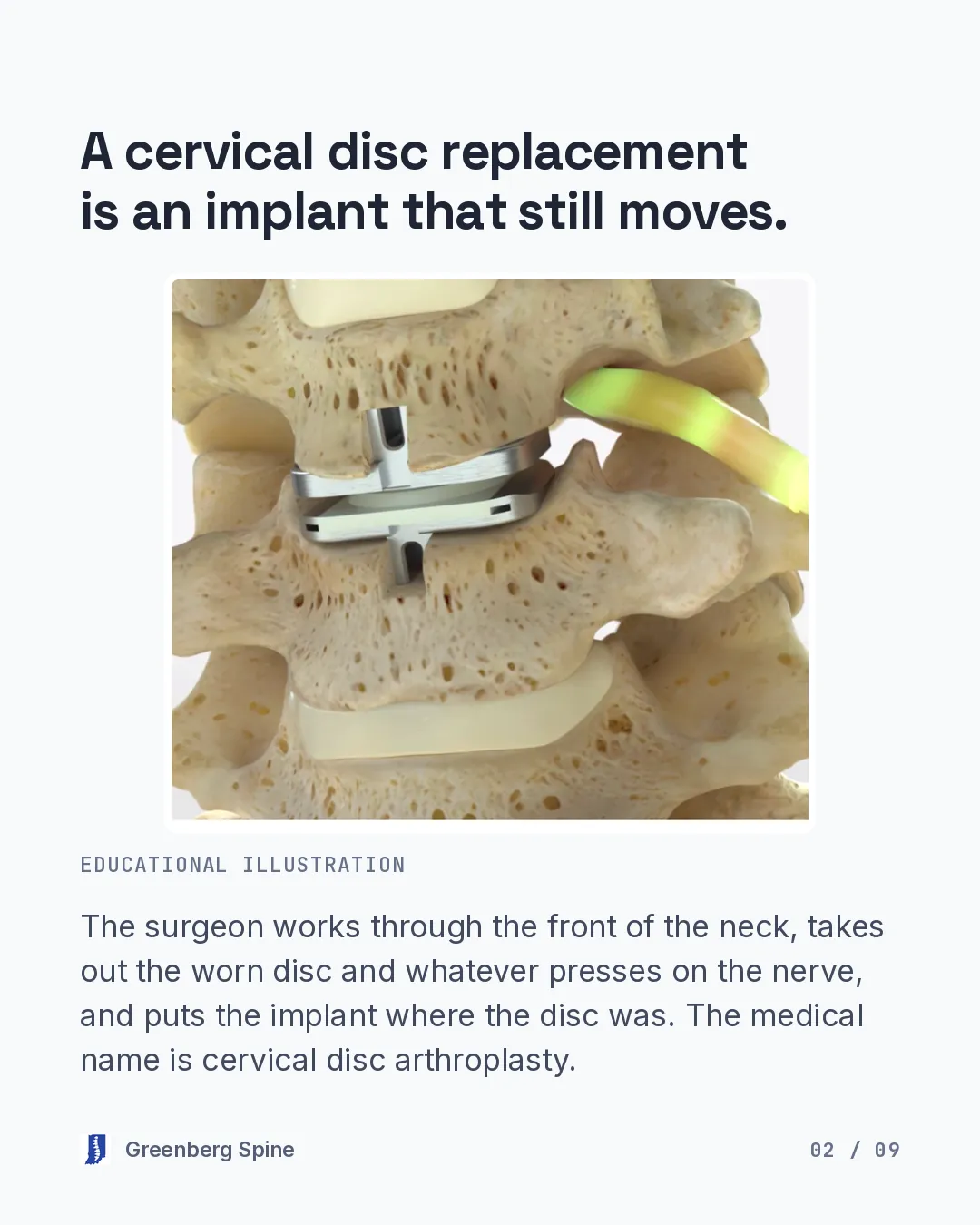
Card 2 of 9 
Card 3 of 9 
Card 4 of 9 
Card 5 of 9 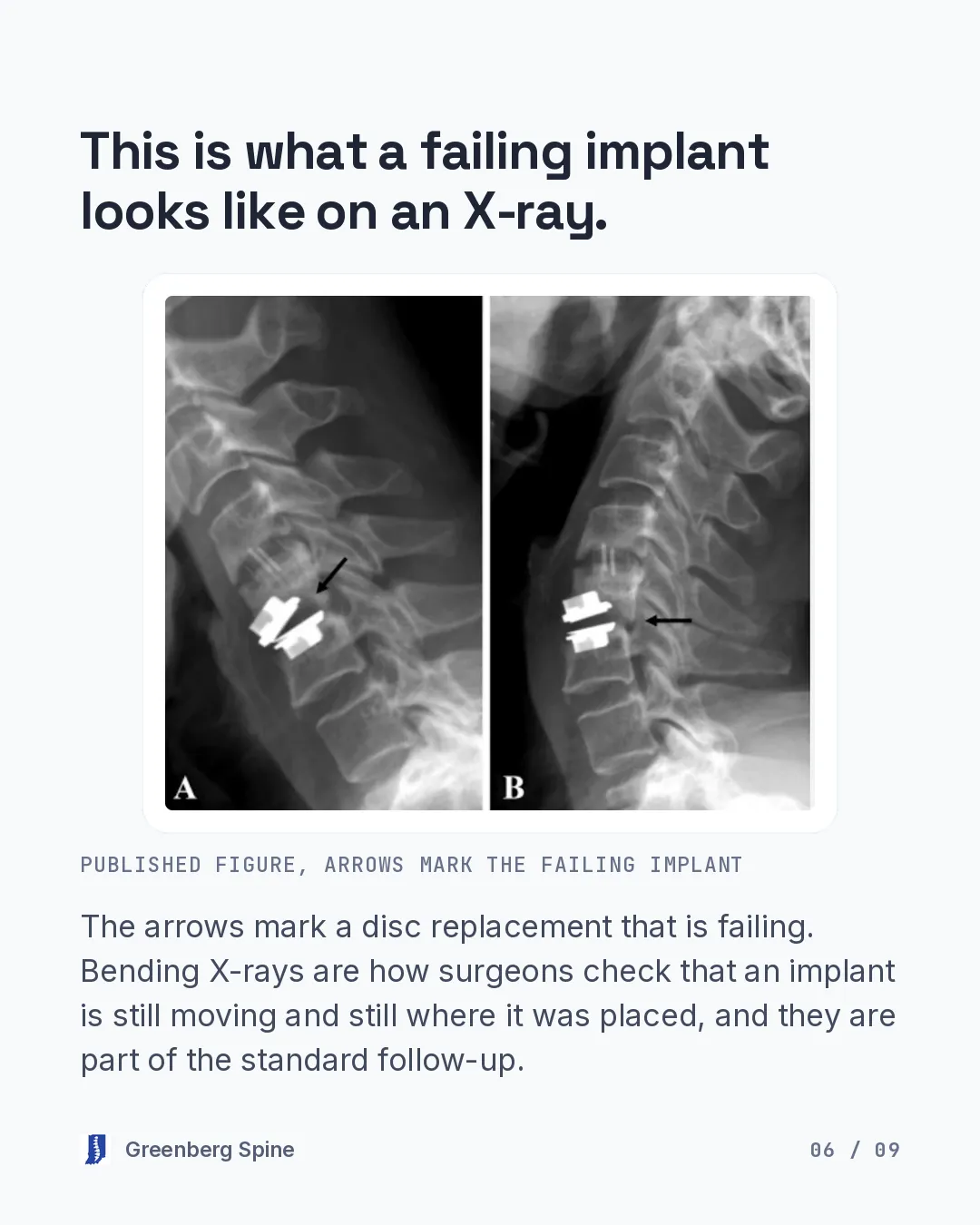
Card 6 of 9 
Card 7 of 9 
Card 8 of 9 
Card 9 of 9
This is general educational information, not medical advice. A clinical evaluation is the only way to know what’s right for you.