Degenerative Disc Disease Treatment in Fort Wayne
Quick Answer
Degenerative disc disease is age-related wear and tear of spinal discs that can cause chronic back pain, stiffness, and pain that worsens with sitting. Most patients improve with physical therapy, activity modification, and anti-inflammatory medications. When conservative care fails, Dr. Marc Greenberg at Greenberg Spine in Fort Wayne offers motion-preserving disc replacement and minimally invasive fusion options.
Comprehensive care for degenerative disc disease using advanced motion-preserving and fusion techniques. Dr. Greenberg offers personalized treatment plans to restore function and reduce pain.
Experiencing symptoms of degenerative disc disease?
Schedule a consultation with Dr. Marc Greenberg to explore minimally invasive options.
Schedule Consultation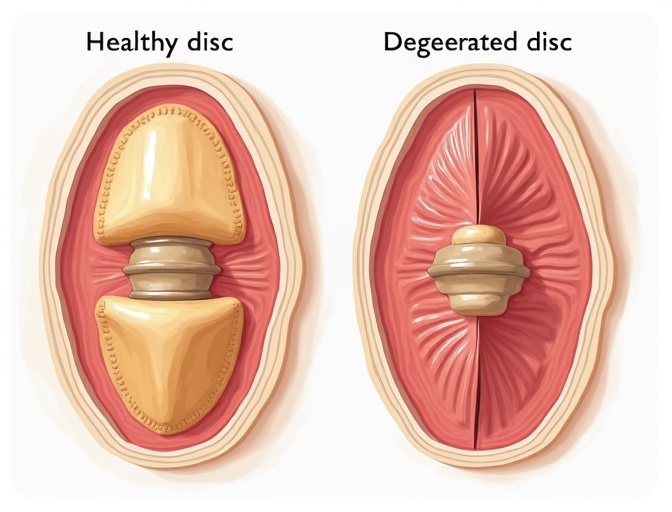
Degenerative disc disease (DDD) is a condition where spinal discs lose their flexibility, elasticity, and shock-absorbing characteristics due to aging and wear and tear. Despite its name, DDD is not actually a disease but rather a natural part of the aging process. However, when disc degeneration causes significant pain or functional limitations, treatment may be necessary. Dr. Marc Greenberg treats degenerative disc disease for Fort Wayne and Northeast Indiana patients with a conservative-first, minimally invasive approach.
At Greenberg Spine, we understand that degenerative disc disease affects each patient differently. Our approach focuses on preserving motion when possible through advanced disc replacement techniques, while also offering fusion options when stabilization is needed. We work closely with each patient to develop a personalized treatment plan that addresses their specific symptoms and lifestyle goals.
Symptoms
Chronic Back Pain
Persistent aching or burning pain in the affected disc area, often worse in the morning.
Pain with Sitting
Increased pain when sitting for extended periods, as sitting puts more pressure on the discs.
Stiffness
Reduced flexibility and range of motion, particularly noticeable after periods of inactivity.
Pain Relief with Movement
Symptoms often improve with walking or changing positions, unlike other spine conditions.

Causes
Natural Aging
Discs naturally lose water content and elasticity as we age, typically beginning in the 30s.
Genetics
Family history plays a significant role in determining susceptibility to disc degeneration.
Smoking
Tobacco use reduces blood flow to discs, accelerating the degeneration process.
Repetitive Stress
Occupational or recreational activities that stress the spine can accelerate disc wear.
Diagnosis
Clinical History
Dr. Greenberg will review your symptoms, pain patterns, and how activities affect your discomfort to identify characteristic signs of disc degeneration.
- Pain pattern analysis
- Activity correlation
- Symptom progression
Imaging Studies
MRI and X-rays reveal disc height loss, dehydration, and other degenerative changes that confirm the diagnosis and guide treatment planning.
- MRI for disc detail
- X-rays for alignment
- Flexion/extension views
Discography
In select cases, discography may be performed to determine if a specific disc is the source of pain before considering surgical intervention.
- Pain source identification
- Surgical planning
- Treatment selection
Conservative Treatment
Initial treatment for degenerative disc disease focuses on managing symptoms and maintaining function through non-surgical approaches. Many patients achieve significant improvement with conservative care.
Physical Therapy
Core strengthening and flexibility exercises to support the spine and reduce disc stress.
Pain Management
Anti-inflammatory medications and pain relievers to manage symptoms.
Weight Management
Maintaining healthy weight to reduce stress on degenerative discs.
Smoking Cessation
Quitting smoking to improve disc nutrition and slow degeneration.
Activity Modification
Adjusting daily activities and work habits to minimize disc stress.
Injections
Epidural or facet joint injections to provide targeted pain relief.
When does degenerative disc disease need surgery?
Surgery for degenerative disc disease is considered when a 6–12 month trial of physical therapy, medications, and activity modification fails to provide meaningful relief, or when progressive weakness, loss of balance, or bowel/bladder dysfunction develops. The specific procedure depends on whether the problematic disc is in the neck or low back.
Red flags that point toward surgery
- Progressive neurological symptoms: Arm or leg weakness that is worsening, gait disturbance, or loss of fine motor control that does not improve with conservative measures.
- Bowel or bladder dysfunction: Loss of control is a surgical emergency — seek immediate evaluation.
- Severe functional impairment: Inability to work, perform daily activities, or maintain quality of life despite a thorough conservative care program.
- Failed comprehensive conservative care: A genuine 6–12 month trial of physical therapy, medications, injections, and lifestyle modifications that has been given a fair chance to work.
When conservative care has been given a fair trial
A meaningful conservative trial for degenerative disc disease typically includes structured physical therapy focused on core strengthening and flexibility, anti-inflammatory medications where appropriate, activity modification, smoking cessation, and weight management. For some patients, epidural or facet joint injections provide additional relief. The key question is not whether a disc looks degenerated on MRI — it is whether the patient's function and quality of life remain substantially impaired after these measures have been consistently applied. An MRI finding alone is not a surgery trigger.
What degenerative disc disease surgery involves
The procedure depends on the location and nature of the disc problem. For cervical (neck) degenerative disc disease, the two main approaches are ACDF (anterior cervical discectomy and fusion), which removes the damaged disc and fuses the vertebrae together, and cervical disc replacement, which preserves motion by implanting an artificial disc. For lumbar (low back) degenerative disc disease, fusion procedures such as TLIF or PLIF stabilize the affected motion segment. Robotic-assisted techniques can improve screw placement precision in fusion procedures. Recovery timelines vary by procedure type and individual factors, and should be discussed during your consultation.
Surgical options for degenerative disc disease in Fort Wayne
Cervical Disc Replacement
Motion-preserving artificial disc for cervical DDD. Maintains natural neck movement while relieving pain from disc degeneration.
Learn moreACDF Surgery
Time-tested fusion procedure for cervical disc degeneration. Direct nerve decompression through a small front-of-neck approach.
Learn moreLumbar Fusion (TLIF/PLIF)
Stabilization procedure for severe lumbar DDD. Minimally invasive techniques available for recovery.
Learn moreRobotic Spinal Fusion
Precision robotic-assisted fusion with navigation guidance for optimal screw placement and alignment.
Learn moreThe right procedure for your condition depends on which disc level is affected, your age, overall health, and treatment goals — all of which should be discussed during a one-on-one consultation with Dr. Greenberg.
When to Consider Surgery
Surgery may be considered when conservative treatments have failed to provide adequate relief and symptoms significantly impact quality of life or when there is progressive neurological deterioration.
Surgical Indications
- Chronic pain lasting more than 6 months
- Significant functional impairment
- Failed conservative treatment
- Progressive neurological symptoms
Why Greenberg Spine
Dr. Greenberg offers advanced surgical options including:
- Motion-preserving disc replacement
- Minimally invasive fusion techniques
- Robotic-assisted precision surgery
- Personalized treatment planning
Related Procedures
Recovery Expectations
Conservative Treatment
Weeks 1-4
Pain management and activity modification
Weeks 4-12
Physical therapy and gradual strengthening
3-6 Months
Ongoing maintenance and lifestyle modifications
Surgical Recovery
Weeks 1-2
Initial healing and pain management
Weeks 2-6
Gradual activity increase and physical therapy
3-6 Months
Return to full activities and long-term recovery
Frequently Asked Questions
When does degenerative disc disease need surgery?
Surgery is considered when a 6–12 month trial of physical therapy, medications, and activity modification fails to provide meaningful relief, or when progressive weakness, loss of balance, or bowel/bladder dysfunction develops. Dr. Greenberg offers cervical disc replacement, ACDF surgery, lumbar fusion (TLIF/PLIF), and robotic spinal fusion depending on the location and severity of disc degeneration.
What is degenerative disc disease?
Degenerative disc disease is a condition where spinal discs lose their flexibility, elasticity, and shock-absorbing characteristics due to aging and wear and tear. It's a natural part of aging that can sometimes cause significant pain.
Is degenerative disc disease progressive?
While disc degeneration is a natural part of aging, the progression varies greatly between individuals. Many people with disc degeneration on imaging never experience significant symptoms, while others may have severe pain from minimal changes.
What are the best treatments for degenerative disc disease?
Treatment typically begins with conservative options like physical therapy, medications, and lifestyle modifications. For severe cases that don't respond to conservative care, surgical options include disc replacement or fusion procedures, depending on the specific situation.
Related Topics
Learn more about related conditions and treatments
Lumbar Fusion (TLIF/PLIF)
Stabilization procedure for severe lumbar degenerative disc disease
Microdiscectomy
Minimally invasive treatment for herniated discs
Herniated Disc Guide
Comprehensive guide to herniated disc symptoms and treatment
Spondylolisthesis
Understanding vertebral slippage and treatment options
Robotic Spinal Fusion: Myths vs Evidence
Evidence-based insights on robotic-assisted spine surgery
Contact Us
Schedule a consultation with Dr. Greenberg
About this content
This page was written and clinically reviewed by Marc Greenberg, MD, a fellowship-trained spine surgeon who trained at Mayo Clinic, Johns Hopkins, and Brown University, practicing in Fort Wayne, Indiana. Information is for educational purposes only and is not a substitute for medical advice from your physician.
Ready to Address Your Degenerative Disc Disease?
Schedule a consultation with Dr. Greenberg to explore both motion-preserving and fusion treatment options.
Schedule ConsultationMedical Disclaimer: The information provided on this page is for educational purposes only and should not be considered medical advice. Always consult with a qualified healthcare provider for proper diagnosis and treatment recommendations. Individual results may vary.
Source: American Association of Neurological Surgeons (AANS) and North American Spine Society (NASS) clinical guidelines.