Blog
ACDF Risks and Complications: An Honest Look at the Numbers

An ACDF takes out a worn disc through the front of the neck, puts a spacer in its place, and holds the level with a plate while the two bones grow together. The common early complaint is a sore or sticky throat. Across published studies about 10 out of 100 fusions do not knit solidly, and the levels next to a fusion can cause trouble years later.
Your neck is built to move, so it is a fair question why a surgeon would deliberately stop one level of it from moving. The answer is that a fusion trades a small amount of motion for taking pressure off a nerve or the spinal cord and keeping the level from shifting. Whether that trade is worth making depends on your anatomy, and it is easier to judge when you know what the operation actually costs. So here are the numbers I think a patient should have before saying yes.
What the operation is
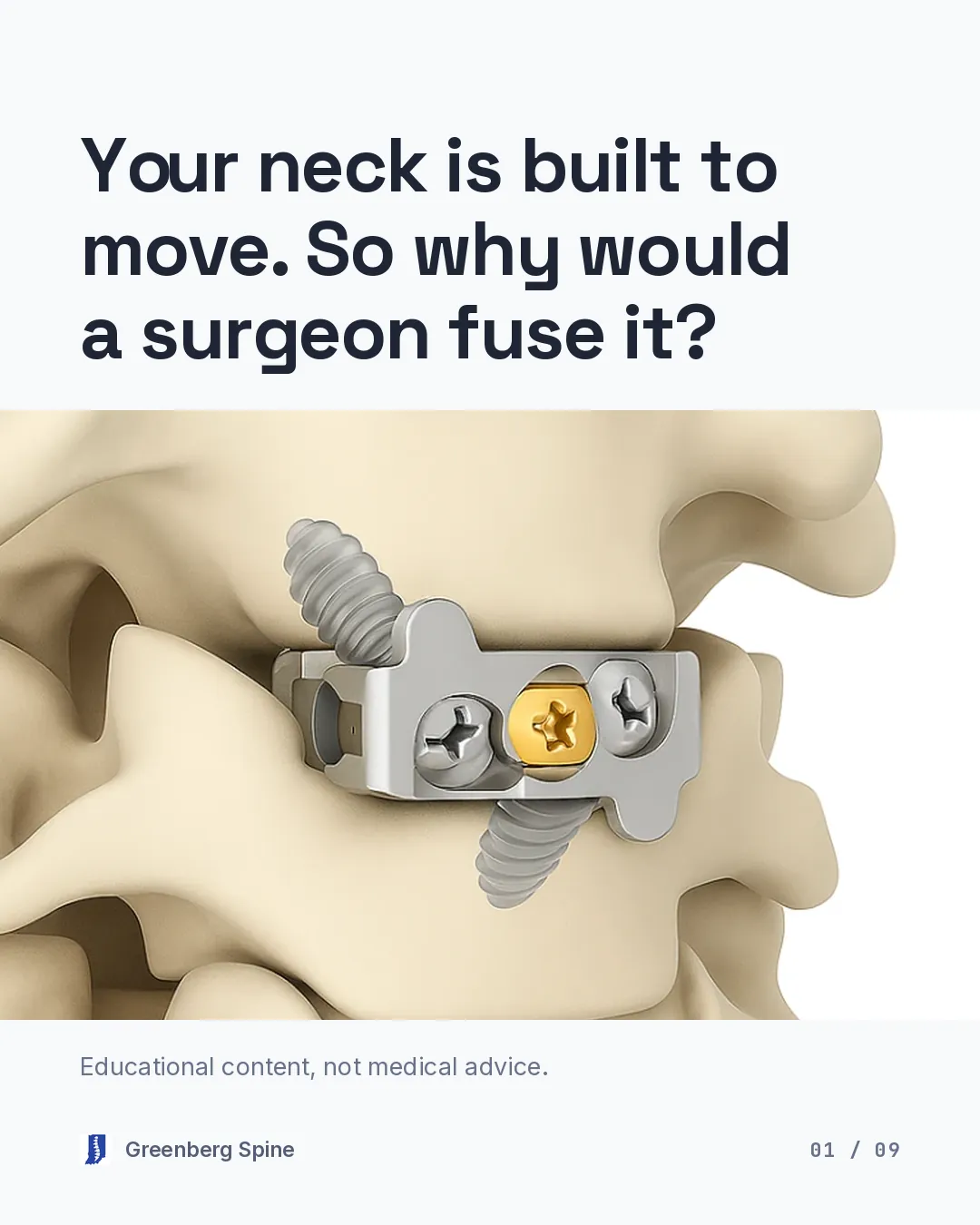
ACDF stands for anterior cervical discectomy and fusion. The surgeon reaches the spine through the front of the neck rather than the back, takes out the disc that is pressing on a nerve root or on the spinal cord, and puts a spacer in the empty disc space to hold the normal height. That spacer is either a small cage or a piece of donor bone. A plate is then anchored into the vertebra above and the vertebra below with screws, and over the following months the two bones grow together into one solid piece. Our ACDF page covers the operation itself step by step.
The plate is not there to be the permanent fix. It holds the level still while the graft turns into bone, and published studies show it raises the chance a level fuses and helps hold the normal curve of the neck.
Who it is for
Two problems account for most of these operations. The first is a disc or bone spur pinching a nerve root, so pain runs down the arm and the hand can feel numb or weak. That is cervical radiculopathy, and surgery is generally considered after at least six weeks of nonsurgical care has failed to settle it, or sooner if the weakness is getting worse.
The second is pressure on the spinal cord itself, which is cervical myelopathy. Myelopathy is handled differently because it tends to progress rather than settle, and guidelines recommend surgery for moderate and severe cases. The symptoms are quieter than people expect, which is why we wrote about the early signs of cervical myelopathy separately.
When a fusion is chosen over a moving implant
For a single level of disc disease in the neck, there is a second option: a cervical disc replacement, which puts in an implant that keeps the level bending. Fusion gets chosen when that implant would not be a safe bet.
The device labels themselves draw most of the line. They rule a replacement out when the level is already loose on bending X-rays, when the facet joints behind the disc are badly worn, when a density scan shows thin bone, and when the neck has lost its normal curve. Deformity and several levels of disease push in the same direction. And when a disc replacement does fail, the usual repair is to take it out and fuse the level, which is one reason a fusion is sometimes the more durable first answer. If you want the two operations laid side by side, start with cervical disc replacement versus ACDF, and how cervical disc replacements fail covers what goes wrong with the moving implant over ten years.
The first weeks are mostly about your throat
Many people go home the same day or after one night. The complaint that dominates the early weeks is not the incision. Because the surgeon works right beside the swallowing tube to reach the front of the spine, a sore or sticky throat is common, and food can feel like it needs a chaser of water.
It generally improves. In one study, about 50 out of 100 people had some trouble swallowing at one month, about 18 out of 100 at six months, and about 13 out of 100 at one year. I would rather tell you that up front than have you discover it while eating dinner and assume something has gone wrong.
The fusion does not always take
This is the risk that most deserves plain language. Across published studies, about 10 out of 100 fusions do not knit solidly. The name for that is a pseudarthrosis, and it can mean ongoing pain and, sometimes, a second operation.
The number of levels changes the picture substantially. With a plate, about 97 out of 100 single-level fusions healed, while about 83 out of 100 three-level fusions healed. A three-level fusion is not simply a longer version of a one-level fusion, and it should not be presented to you as one.
Years later, the neighbors
Fusing one level asks the levels above and below to do more work, and over time some of them protest. In a study that followed 374 patients, new nerve or cord symptoms appeared at a neighboring level in about 3 out of 100 patients each year, and in about 26 out of 100 within ten years.
That single figure is the reason motion-preserving disc replacements were developed at all. It is also why the choice between the two operations is really a choice about what you are optimizing for over a decade, not over a month. Guidelines still call the two comparable in the short term at a single level.
What I want you to take from the numbers
None of this is an argument against an ACDF. It is a well-understood operation that reliably takes pressure off a nerve, and for a great many necks it is the right answer. The point is that every one of these figures has a name, a source, and a range, and you are entitled to hear them before you consent rather than afterward.
Bring your MRI and your questions. I only operate when it’s truly the right thing for the patient, and when they’ve exhausted every other option first. You can request a consultation or ask for a second opinion if someone has already told you that you need a fusion.
Sources
- Postoperative complications of anterior cervical discectomy and fusion: systematic review and meta-analysis
- Anterior approaches to fusion of the cervical spine: a metaanalysis of fusion rates
- Incidence of dysphagia after anterior cervical spine surgery: a prospective study
- Risk factors for dysphagia after anterior cervical spine surgery
- Radiculopathy and myelopathy at segments adjacent to the site of a previous anterior cervical arthrodesis
- Adjacent segment disease after cervical disc arthroplasty versus fusion
- Mobi-C cervical disc prosthesis, FDA instructions for use
- North American Spine Society guideline: cervical radiculopathy from degenerative disorders
- Clinical practice guideline for the management of degenerative cervical myelopathy
- Cost analysis of anterior cervical discectomy and fusion in the outpatient setting
- Rate of fusion after anterior cervical discectomy and fusion assessed at twelve months or later
The slides, one at a time
These are the cards from the carousel version of this article. Each one stands on its own, so you can read them in order or stop at the one you came for.
Card 1 of 9 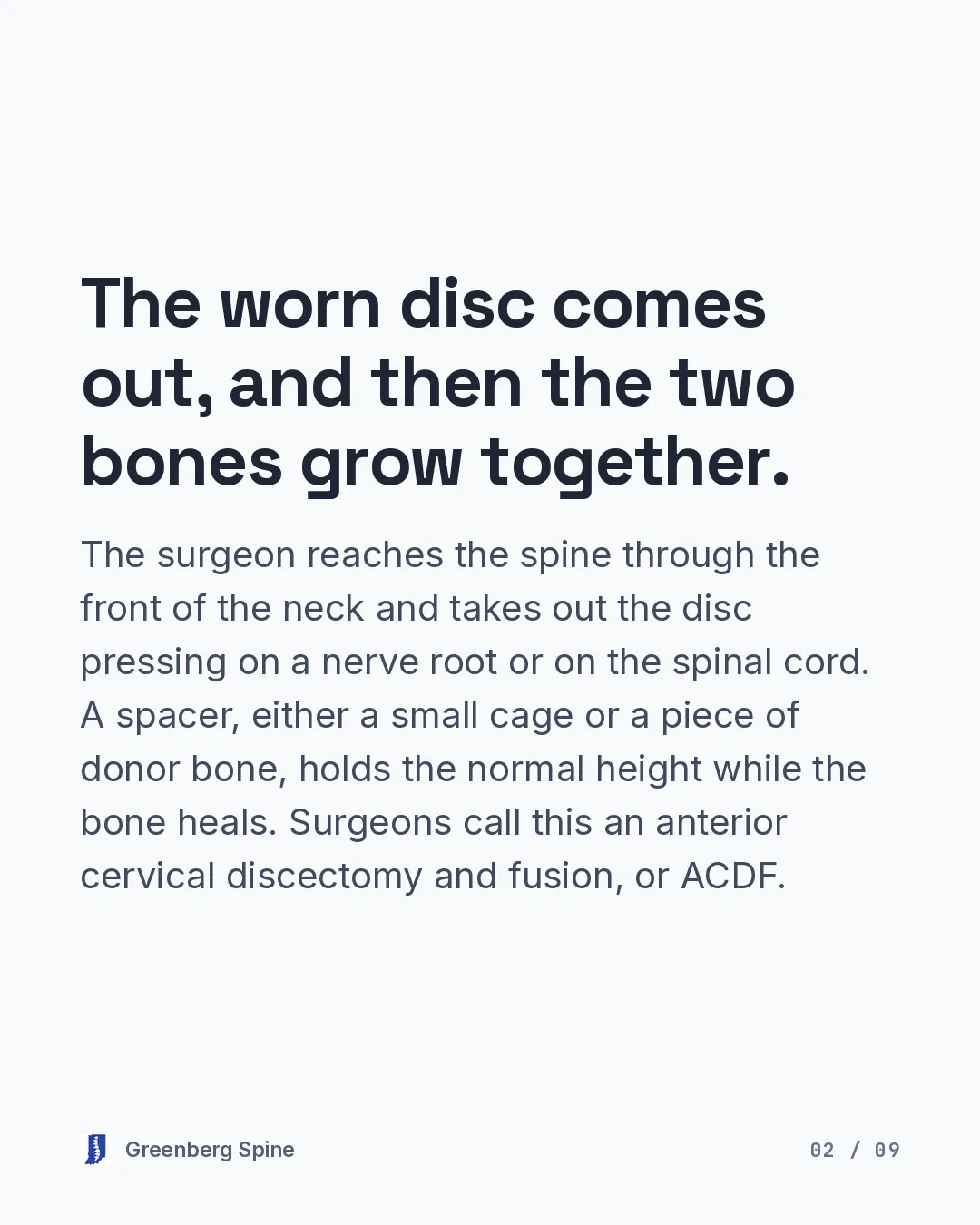
Card 2 of 9 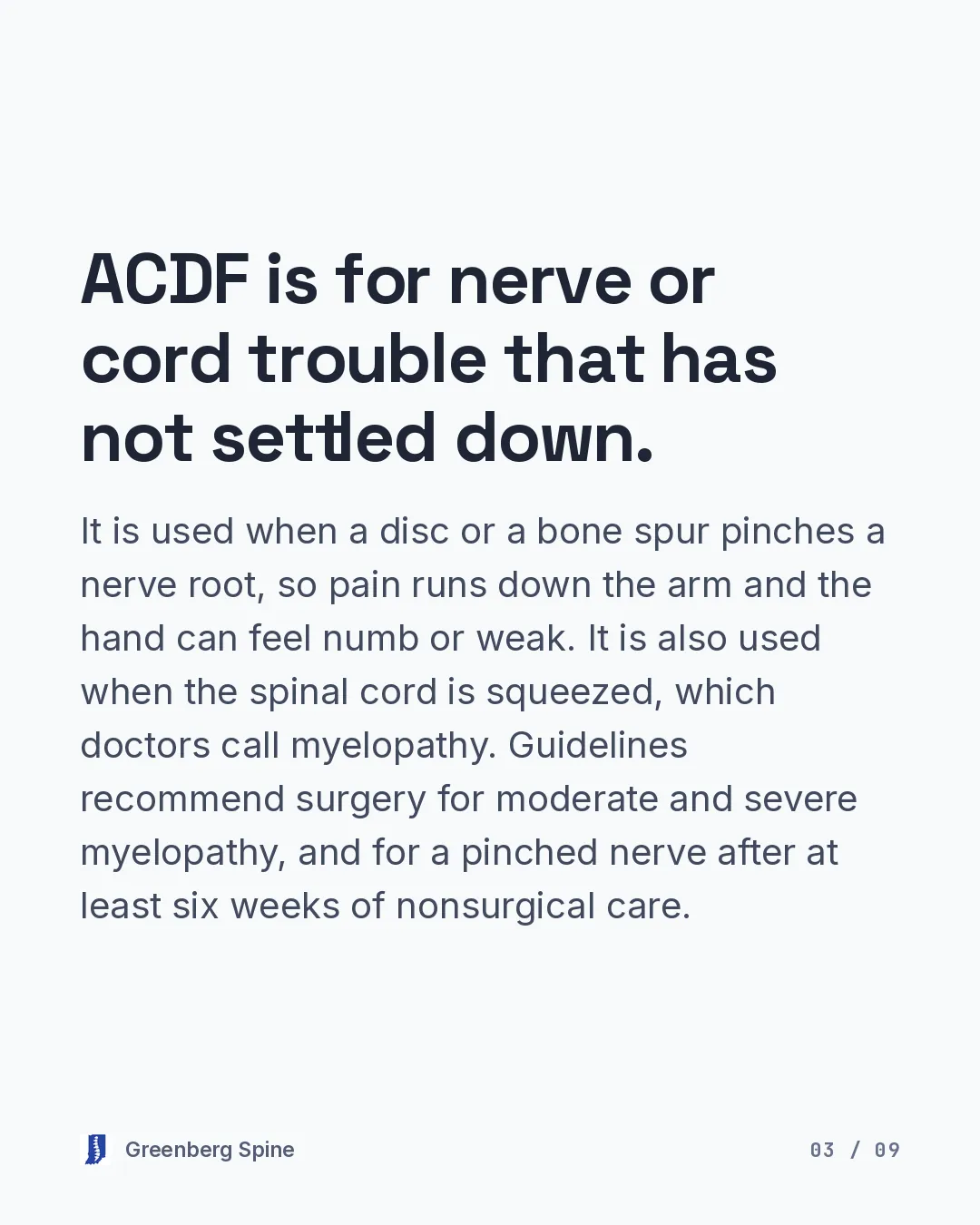
Card 3 of 9 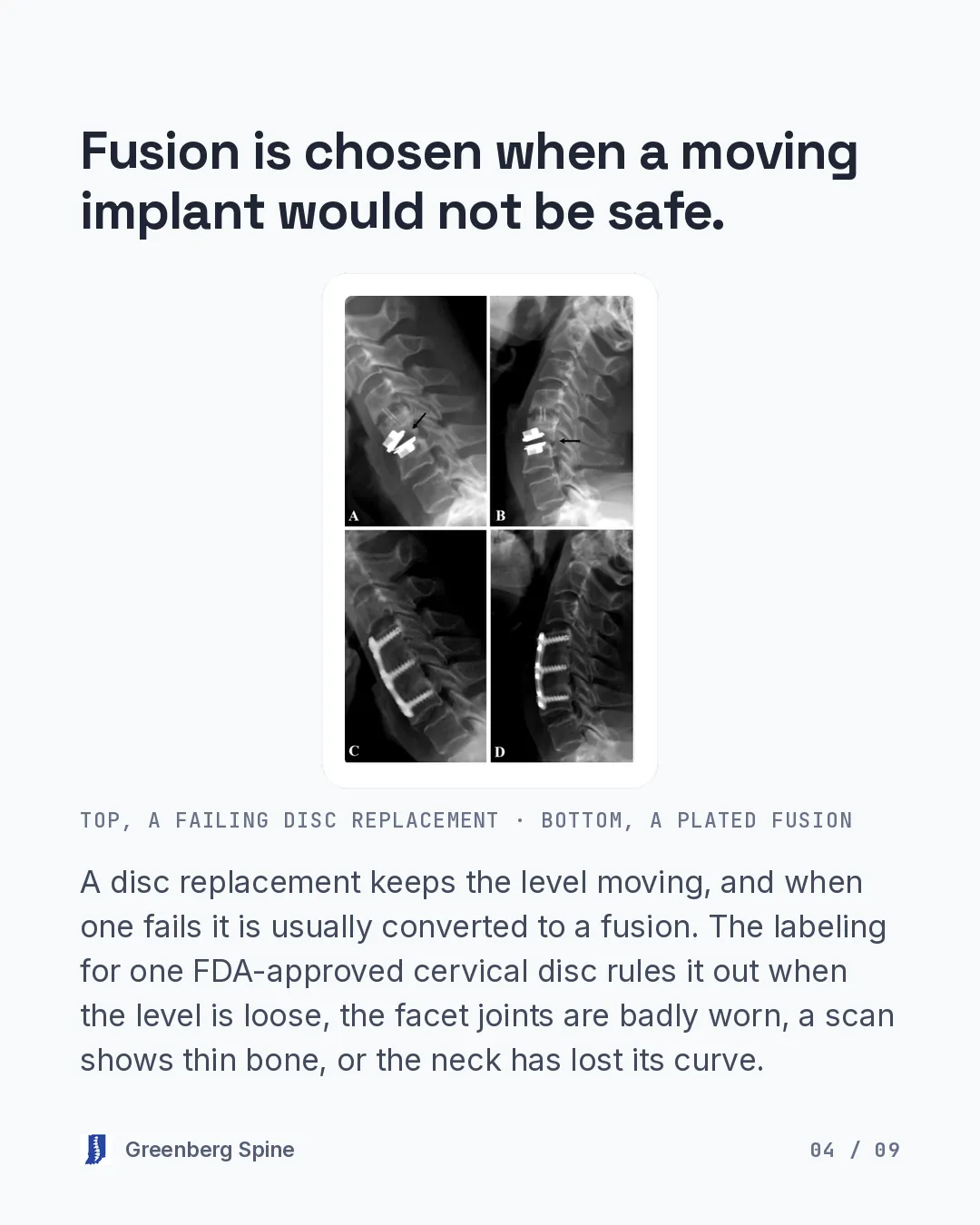
Card 4 of 9 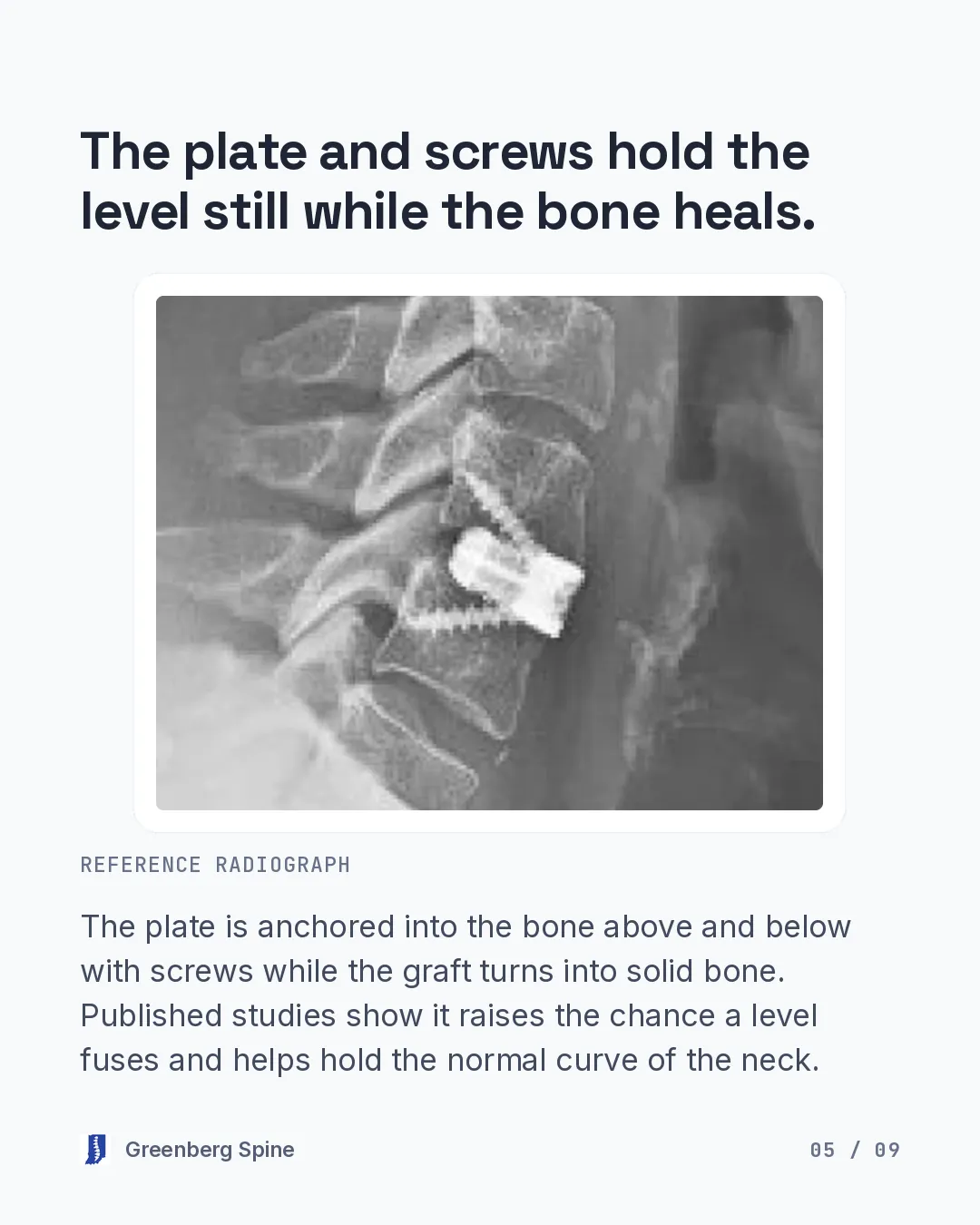
Card 5 of 9 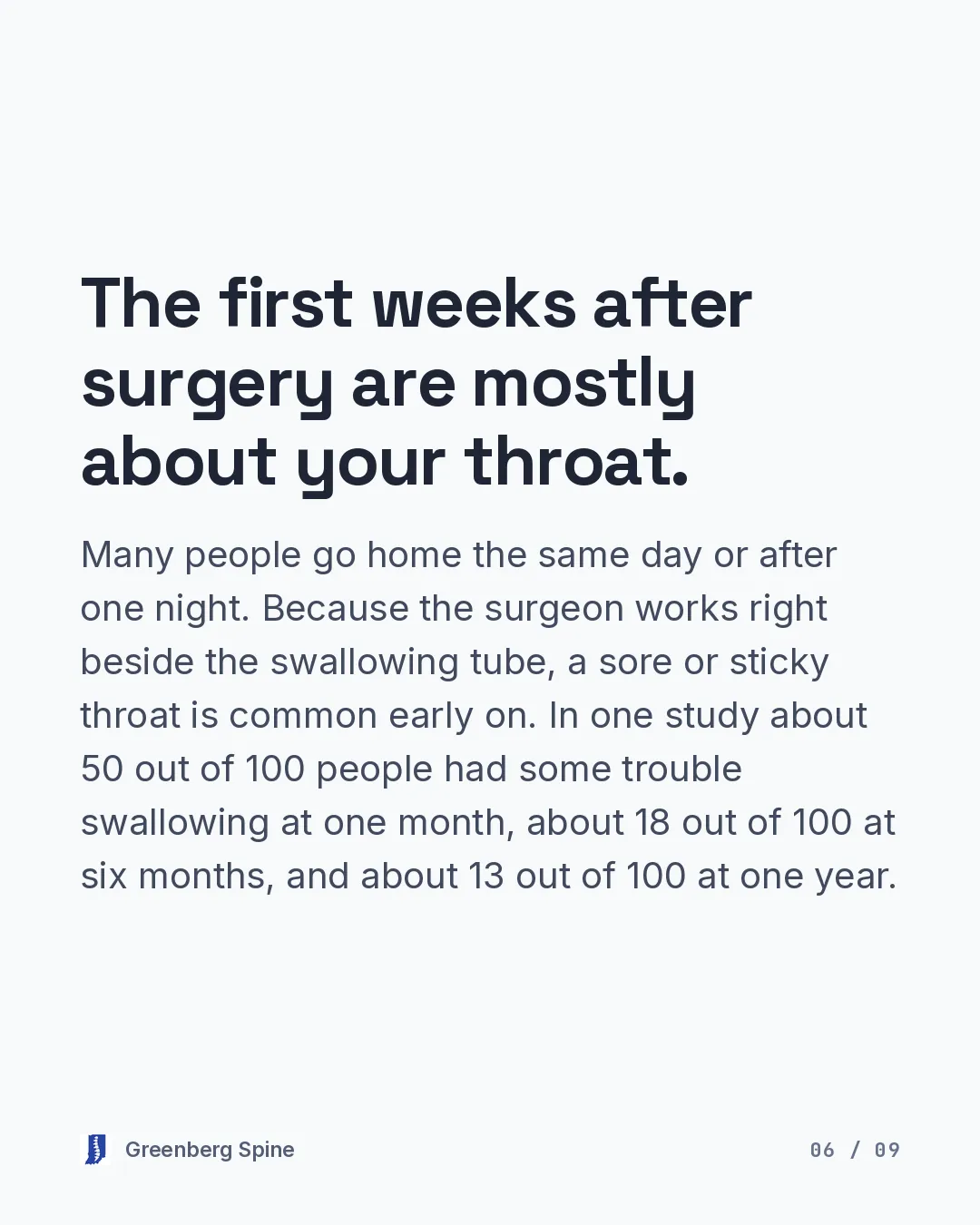
Card 6 of 9 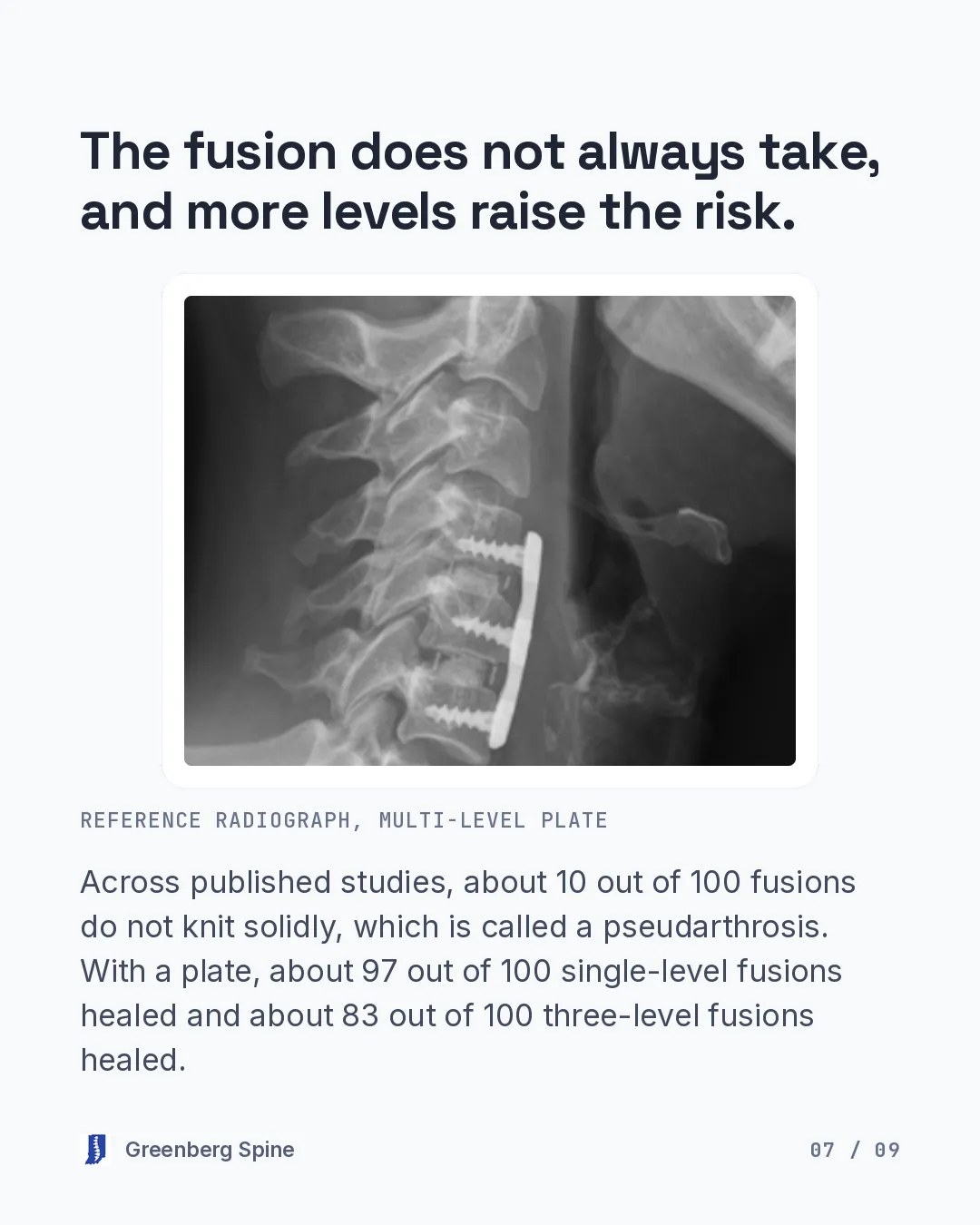
Card 7 of 9 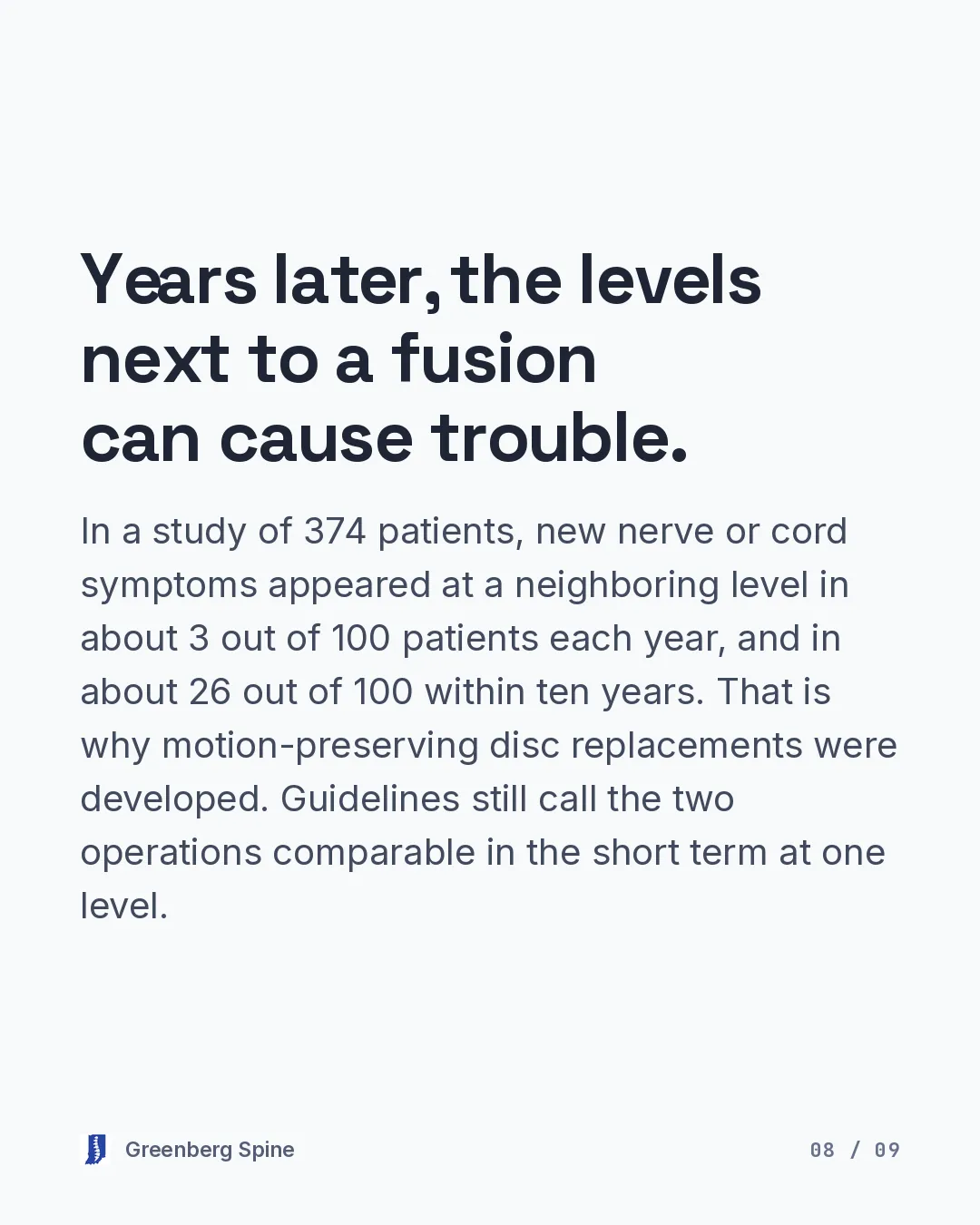
Card 8 of 9 
Card 9 of 9
This is general educational information, not medical advice. A clinical evaluation is the only way to know what’s right for you.