Key points from this video
- The primary goal is adequate nerve decompression, not the smallest possible incision.
- Tubular, endoscopic, and conventional techniques are different tools rather than a simple hierarchy.
- Some patients need decompression alone; others may have instability, deformity, or another reason to discuss fusion.
- Recovery depends on the diagnosis, number of levels, neurologic symptoms, health, and exact procedure—not the marketing label alone.
What this video can—and cannot—tell you
“Minimally invasive” describes how the surgeon reaches the problem; it does not define one operation or guarantee an easier recovery. The meaningful comparison is whether the chosen access provides enough visualization and decompression while preserving structures that do not need to be disturbed.
This is general educational information, not medical advice. Symptoms vary by person — a clinical evaluation is the only way to know what’s right for you.
Full video transcript
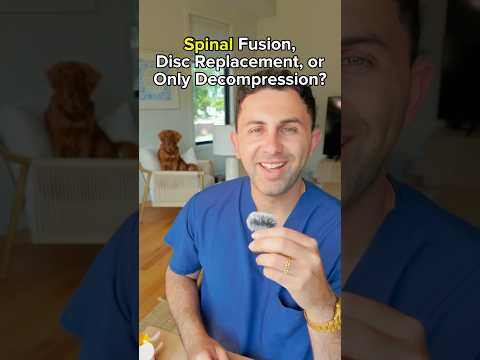
Dr. Greenberg points to a spine model while an MRI and anatomy illustrations accompany the explanation. A comparison diagram labels the open and minimally invasive approaches and contrasts a wider surgical exposure with a focused tubular approach.
Do you have to stay in the hospital for days after a laminectomy, or is there a way to go home the same day without a ton of pain? Thankfully, there are minimally invasive options that now exist that may get you home sooner and out of pain faster.
First off, what even is a laminectomy? Well, a laminectomy is essentially the removal of the roof of the spine. For a variety of reasons, ligament thickening, cysts, disc herniation, facet overgrowth, all of those things end up compressing the nerve that run down your legs and crush those nerves.
This MRI is from one of my patients who came in for a second opinion. She was having signs and symptoms of something called neurogenic claudication, which is when those nerves are so compressed that you literally start to be unable to walk for long distances. People describe it as a cramping feeling and uh just like this terrible generalized weakness in their legs.
Unfortunately, when you leave it alone for long enough, it doesn't get better. It typically gets worse and a lot worse.
Her surgeon, who she originally saw, recommended an open laminectomy to remove the pressure, which is totally reasonable. At the end of the day, a well-done open laminectomy can have great results. But in the short-term, there can be a significant amount of pain from the amount of muscle that has to be stripped and destroyed to do it safely.
Thankfully, that's not the only option. You can see in the diagram that the open laminectomy requires a huge incision. Whereas the minimally invasive tubular option exposes only the specific amount of bone necessary to do the surgery.
She ended up deciding to go with me and do the minimally invasive laminectomy, and she was actually able to leave the hospital the same day. And when I called her to follow up the next day, she was actually going for a walk.
So, if you were told you need a lam- laminectomy, don't panic. Ask your surgeon if there's a minimally invasive option available for you.